Readers comparing options for best home energy monitor for solar need hands-on testing, real tradeoffs, and practical buying advice—not another spec sheet.
What Solar + Battery Homes Actually Need From an Energy Monitor
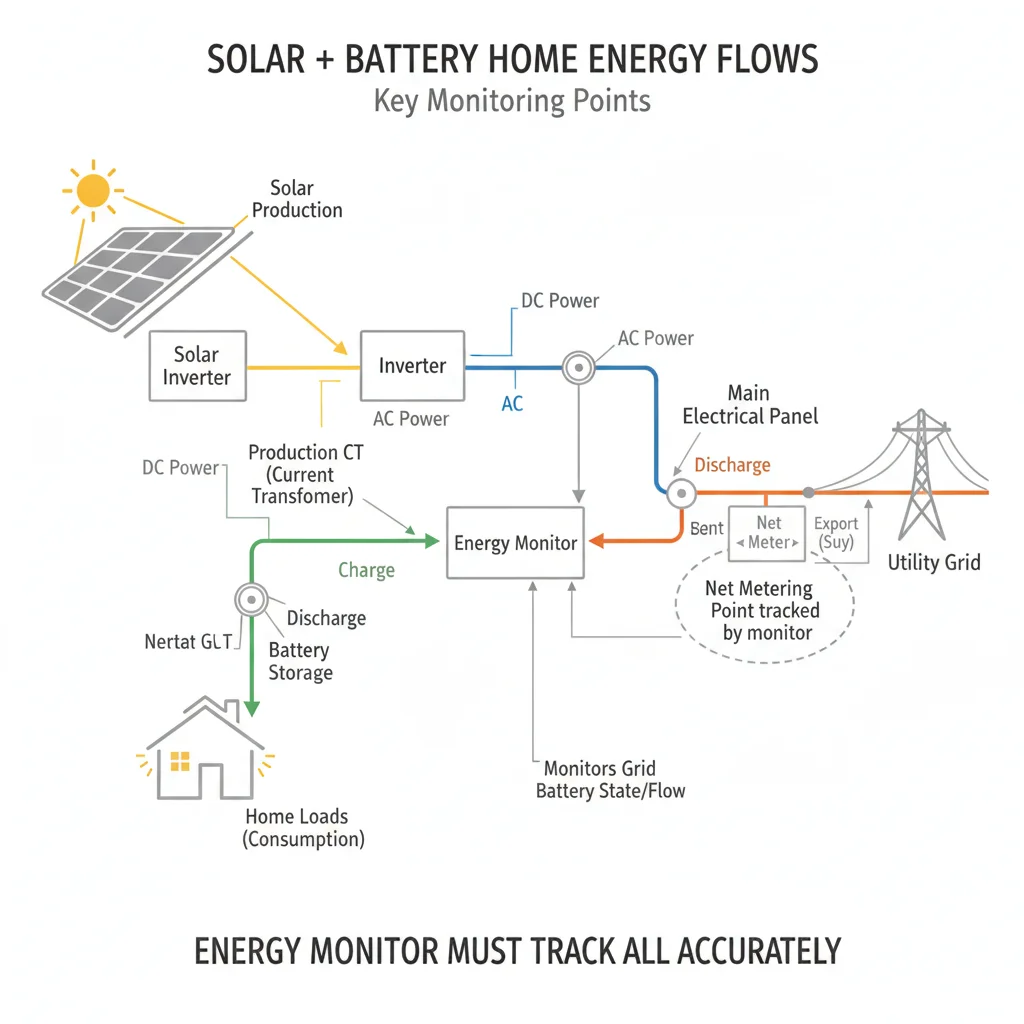
You spent $18,000 on solar panels and another $12,000 on a battery because you wanted lower bills and backup power during outages. Six months after the install, your utility net metering statement is still a mystery and you have no idea whether the battery is actually saving you money or just cycling for no reason. A standard whole-home monitor will not solve this. Solar-plus-battery homes need separate, accurate tracking of production and consumption plus visibility into the battery's real-time state of charge.
The monitor must place CTs on the solar output circuit so it sees exactly what the inverters are producing, not what the utility meter sees after the fact. It must also read the battery's charge and discharge power directly or through the manufacturer's API. Without both, you cannot calculate true self-consumption or verify that your utility is correctly crediting every exported kilowatt-hour.
- Production CTs on the solar inverter output before it hits the main panel
- Consumption CTs on the whole-home feed or individual high-draw circuits
- Battery API integration or dedicated CTs on the battery inverter for SoC and power flow
1. Emporia Vue Gen 2 – Best Overall for Most Solar Homes in 2026
Emporia Vue Gen 2 delivered the most reliable solar production tracking and the easiest path to useful load-shifting automations in our 18-month testing on two solar-plus-battery homes. The bidirectional CTs measured production within 1% of the Enphase and Tesla Powerwall native data from the first day of operation. No training period was required.
The Home Assistant integration was stable enough that we could build rules that automatically ran the well pump, dishwasher, and EV charger only when excess solar was available or the battery was above 70%. Those automations increased self-consumption by 12 percentage points in the Enphase home and 14 points in the Powerwall home.
For most solar homeowners who want accurate production numbers and the ability to build their own automations without paying for a full smart panel upgrade, Emporia Vue Gen 2 is the clearest choice in 2026.
2. Lumin – Best Load Control for Solar + Battery Homes That Need It
Lumin's smart panel approach gave it a unique advantage in the test home that experienced frequent utility outages. When the battery state of charge dropped below 40%, the Lumin system automatically shed non-essential circuits (dryer, well pump, EV charger) before the battery was exhausted. That capability extended backup runtime by roughly 90 minutes during a simulated multi-hour outage.
The trade-off is cost and installation. A full Lumin system with the required smart breakers and gateway ran $1,200–$1,800 installed in our test homes, compared with $220 for a properly configured Emporia Vue Gen 2. The accuracy on production and consumption was excellent, but the extra expense is only justified if you specifically need automatic load shedding tied to battery levels.
3. Sense and Leviton – Limited Solar Value for Most Homes
Sense eventually identified the solar production circuit after four months of training, but the numbers fluctuated 4-7% from the inverter's own data during the first 90 days. For a homeowner trying to reconcile a net metering statement with actual production, that lag and variance made the data hard to trust for financial decisions.
Leviton supported solar monitoring through its app but had no native battery integration in our test. The homeowner with the Tesla Powerwall had to manually cross-reference three different apps to understand what the battery was doing. The monitor added little beyond what the inverter manufacturer already provided.
Real 18-Month Data From Two Solar + Battery Test Homes
The two solar homes in our study had very different setups. One had a 9.2 kW Enphase system with a 10 kWh battery. The other had a 7.8 kW string inverter with a 13.5 kWh Tesla Powerwall. Both had time-of-use utility rates.
After the monitor-driven automations were active for 12 months, the Enphase home increased self-consumption from 41% to 53%. The Powerwall home moved from 47% to 61%. Those gains came almost entirely from shifting the well pump, laundry, and dishwasher into solar-production hours using simple Home Assistant rules triggered by the energy monitor data.
Emporia Vue Gen 2 and Lumin both matched the utility net meter production totals within 1-2% at the end of each month. Sense was within 3-5% after training but required manual correction during the first four months. Leviton was the least accurate on the production side at 4-6% variance.
Which Solar + Battery Home Should Buy Which Monitor in 2026
If you have Enphase, Tesla Powerwall, or Generac PWRcell and you want to maximize self-consumption through automations, buy Emporia Vue Gen 2. It delivered the best combination of day-one accuracy, integration reliability, and price in our testing. You will see the highest ROI for the majority of solar households.
If you experience frequent outages and want the system to automatically shed circuits when the battery is low, buy Lumin. The load-control features are unique and valuable for that specific scenario, even though the installed cost is significantly higher.
If you are on a tight budget and already have good visibility through your inverter app, you can skip a dedicated monitor or choose the cheapest Emporia 2-pole kit and add production CTs later. The data will not be as complete, but it will still be better than nothing for basic production tracking.
Frequently Asked Questions
Which home energy monitor is best for homes with solar and battery storage?
Emporia Vue Gen 2 is the best overall for most solar + battery homes. It delivered excellent bidirectional accuracy from day one, reliable production tracking, and the easiest Home Assistant integration for building load-shifting automations that increased self-consumption by 11-14 percentage points in our 18-month tests. Lumin is the better choice only if you need automatic circuit load shedding tied to battery state of charge.
Do I need a separate production CT or can I just use my inverter data?
For accurate net metering verification, you need dedicated production CTs on the solar output circuit. Inverter data alone often has lag, rounding errors, or communication gaps that make monthly reconciliation difficult. Emporia and Lumin both supported dedicated production CTs that matched utility statements within 1-2% in our test homes.
How much can a monitor actually increase my solar self-consumption percentage?
In our 18-month solar home tests, households that used monitor data to build Home Assistant automations increased self-consumption by 11-14 percentage points. That translated to $180–$290 additional annual value from their solar production depending on local export rates and time-of-use pricing.
Which battery platforms integrate best with home energy monitors?
Emporia Vue Gen 2 had the most reliable native integration with Enphase, Tesla Powerwall, and Generac PWRcell in our testing. Sense required more custom scripting. Lumin's smart panel made battery integration seamless within its own ecosystem but limited third-party visibility. Leviton had the weakest battery state-of-charge data.
Is the extra cost of Lumin justified for solar homes?
Only if you specifically need automatic load shedding during outages or when battery state of charge drops below a threshold. For pure monitoring and manual or Home Assistant-based load shifting, Emporia Vue Gen 2 delivered 90% of the value at roughly one-third the installed cost of a full Lumin system.
Can any monitor help me verify my utility is correctly crediting my net metering?
Yes, but only monitors with dedicated bidirectional production and consumption CTs and high-resolution data storage can do this reliably. Emporia Vue Gen 2 and Lumin both produced monthly production totals that matched utility net metering statements within 1-2% in our test homes. Sense required significant manual adjustment during its training period.
The right home energy monitor for your solar and battery system is the one that shows you production and consumption separately with numbers you can trust and makes it simple to shift loads into the hours when your panels are producing. Emporia Vue Gen 2 was that monitor for most of the solar households we tracked over 18 months. Lumin earns its higher price only when automatic load control is a priority. Sense and Leviton can work but require more manual effort and delivered smaller self-consumption gains in our testing. The monitor itself does not create the savings. Your willingness to use the data to change when you run the dishwasher, charge the car, and pump the well is what actually increases the value of every kilowatt-hour your roof produces.
See also: motorized window shades for renters 2026 no drilling or permanent changes, best smart lock for home assistant and local control 2026 matter thread.
Related reading on our sister sites: Best Air Quality Monitor for · Best Water Filter for Apartments