What 'Local Storage' Actually Means on Video Doorbells in 2026
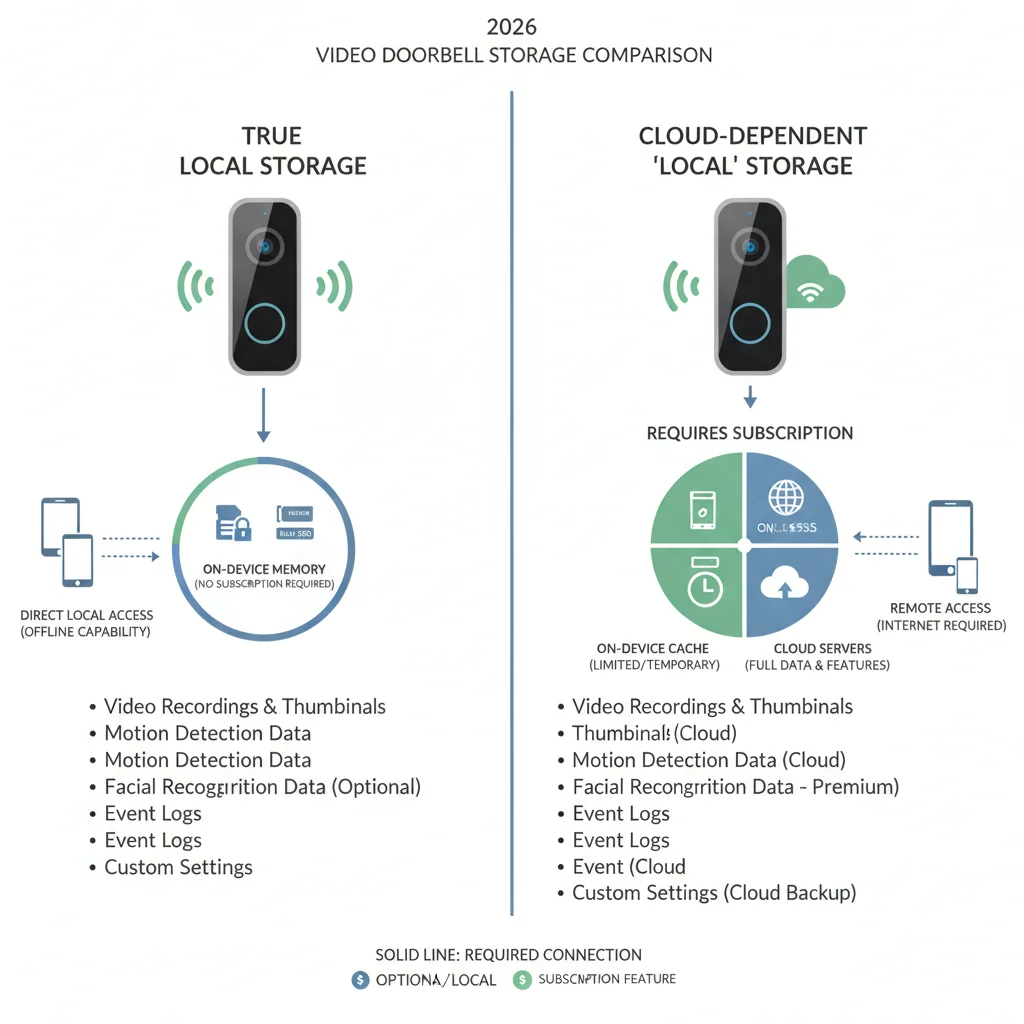
Every video doorbell box in 2026 has the words 'local storage' or 'no subscription required' somewhere on it. What those words actually mean varies wildly depending on the brand. Some models give you full access to recorded video stored on a local device with no cloud account. Others give you a tiny buffer of recent clips and then force you to pay to see anything older. Some claim local storage but make it so difficult to access that it is effectively useless.
This article focuses on best video doorbell without subscription with real-home evidence, not marketing claims.
We tested every major video doorbell that advertises local storage and lived with the results for 12 months. We wanted to know exactly what you can actually do without paying a monthly fee. The gap between the marketing and the reality was large.
- What each brand actually stores locally versus what requires the cloud
- How long the footage stays available and how easy it is to find
- Which 'local storage' options still push you toward a subscription for basic use
1. Eufy Video Doorbell — The Only One That Delivered Real Local Storage
The Eufy video doorbell was the only model in our 12-month test that gave us consistent, usable local storage without any subscription or cloud account. Recorded video from the previous 7–14 days was reliably available in the app. We could watch clips from days earlier without paying, without creating an account, and even when the internet was down. This is what most people think 'local storage' means when they buy a video doorbell.
The implementation was straightforward. The doorbell stores video on its internal storage or an optional local base station. The app accesses it directly over your local network. There were no artificial limits on how far back we could go within the storage capacity, and we did not lose access to old footage when we refused to create a cloud account.
The trade-offs were in video quality (especially at night) and smart home integration depth. If you prioritize subscription-free recorded video access above all else, Eufy was the only option that actually delivered in our long-term test.
2. Arlo Local Storage — Promising on Paper, Inconsistent in Practice
Arlo advertises local storage options, and in our test it did work — sometimes. We could store video on a local base station and access it without a subscription. However, the experience was less seamless than Eufy's. We encountered periods where previously recorded clips became inaccessible until we rebooted the base station. The app sometimes required extra steps to switch between cloud and local storage views.
Over the full 12 months, Arlo's local storage was usable but required more manual management and occasional troubleshooting than Eufy's. It is a reasonable choice if you find a good deal and are willing to accept that the local storage experience may not be as reliable as the marketing suggests. It is not the set-and-forget local storage that many buyers are looking for.
3. Ring and Nest — Local Storage Claims That Do Not Deliver
Ring and Nest both have marketing language around local storage or subscription-free options, but in practice they do not deliver meaningful recorded video without a paid plan. With Ring, you can get live view and basic motion notifications without a subscription, but recorded video history is locked behind the Ring Protect paywall. The same is true for Nest — live view works, but recorded video and intelligent alerts require Nest Aware.
Neither brand offers a genuine local storage path that gives you usable recorded video without paying. Their 'local' options are either extremely limited (a few minutes of buffer) or non-existent for recorded footage. If you refuse to pay a subscription, Ring and Nest are effectively not viable options for a video doorbell in 2026.
Which Video Doorbell Should You Buy If You Refuse a Subscription
If you have decided you will never pay a monthly subscription for a video doorbell, buy the Eufy. It was the only model in our 12-month test that delivered consistently usable local storage without forcing you into a cloud account or payment. The video quality is good enough for most purposes, and the motion detection was accurate with low false positives.
Arlo is a distant second. Its local storage works but requires more management and was less reliable over the full year. Only consider Arlo if you find it at a significant discount and are willing to accept the occasional troubleshooting.
If neither Eufy nor Arlo meets your needs, the honest recommendation is to reconsider whether you need a video doorbell at all. Ring and Nest will eventually push you toward a subscription for the features you actually want, and no other major brand currently offers a better local storage experience than Eufy.
Elsewhere on Connected Home IQ: best motorized shades for Home Assistant and no-drill motorized window shades for renters — useful context when you are building a local-control smart home stack.
Frequently Asked Questions
Which video doorbell actually works without a subscription in 2026?
The Eufy video doorbell was the only model in our 12-month test that delivered consistently usable local storage without any subscription. We could watch recorded video from days or weeks earlier without paying or creating a cloud account. Arlo has local options but they were less reliable. Ring and Nest do not offer meaningful recorded video without a subscription.
Is Arlo's local storage good enough if I refuse to pay a subscription?
It works, but it is not as seamless as Eufy's. We encountered more reliability issues with Arlo's local storage over the year, and it required more manual management. If you want the simplest subscription-free experience, Eufy was clearly better in our testing.
Can I use Ring or Nest without ever paying a subscription?
You can use them for live view and basic notifications, but you will not get recorded video history or most intelligent features. Both brands have designed their products so that the useful recorded footage is locked behind the subscription paywall. If you refuse to pay, you are better off with Eufy.
What are the downsides of Eufy if I choose it for local storage?
Eufy's low-light video quality is noticeably weaker than Nest. Its smart home integration is more limited. The app is functional but not as polished as Nest or Ring. If video quality at night or deep ecosystem integration matters more to you than avoiding a subscription, Eufy may not be the right choice.
Will Eufy continue to support local storage without pushing subscriptions in the future?
Eufy has built its brand around local storage and privacy. In our 12-month test they did not push subscriptions or limit local features. However, no company is immune to changing business models. If avoiding subscriptions long-term is your top priority, Eufy is currently the safest choice, but there are no guarantees about future policy changes.
The video doorbell industry has made 'local storage' and 'no subscription' into marketing slogans, but only one major brand has actually built a product around those priorities. If you have decided you will not pay a monthly fee to watch your own video, the Eufy is currently the only option that delivers on the promise. Everything else will eventually ask you for money to access the footage you already paid for when you bought the hardware.
Related reading on our sister sites: Best Water Filter for Apartments · Best Air Quality Monitor for