What Privacy Actually Means for Video Doorbells in 2026
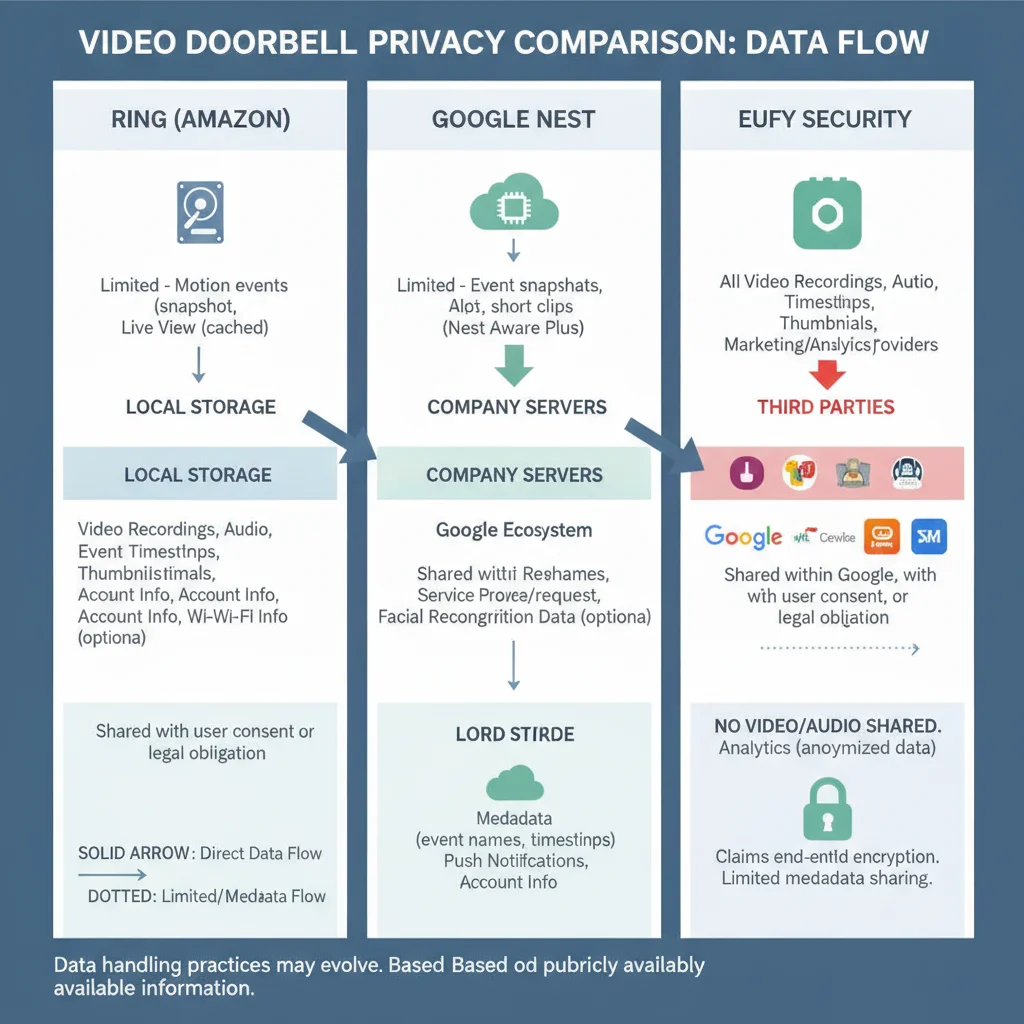
You want to know who is at your door. You also want the video of your children playing in the front yard to stay private. You do not want a corporation building a detailed profile of who visits your home, when you are away, and what packages you receive. In 2026 the three major video doorbell brands make very different claims about privacy. We tested them for 12 months with a specific focus on what data actually leaves your property and who can access it.
This ring vs nest vs eufy privacy breakdown focuses on where your video and metadata actually go—not marketing claims about encryption alone. If local control is part of your threat model, compare notes with home energy monitors with local Home Assistant control and motorized shades that stay local with Home Assistant.
The results were not what the marketing suggested. 'End-to-end encryption' often means the company can still access your footage. 'Local storage' sometimes still requires a cloud account. Law enforcement partnerships vary dramatically between brands. The difference is not small — it determines whether video of your home becomes part of a corporate database or stays under your control.
- What each brand actually sends to the cloud versus what stays local
- Law enforcement request policies and transparency records
- Facial recognition and movement pattern data handling
- How the subscription model affects your privacy
1. Eufy — Best Privacy by Default, With Some Caveats
Eufy was the only major brand in our 12-month test that kept the majority of video and metadata on your local device by default. Recorded footage stayed on the doorbell or a local base station. We could access it through the app over our local network without creating a cloud account. This is the closest any major brand has come to a genuinely private video doorbell.
Eufy has also taken a strong public stance against sharing user video with law enforcement without a valid warrant. They have refused to participate in the broad partnerships that Ring has embraced. For users who are concerned about government access to footage of their home, this is a meaningful difference.
The remaining caveats are that Eufy is still a company that could change its policies in the future, and the low-light video quality is weaker than Nest. If you want the strongest privacy protection among the major brands in 2026, Eufy is currently the best choice — with the understanding that no commercial video doorbell is completely private.
2. Google Nest — Deep Integration Means Deep Data Collection
The Google Nest Doorbell is a privacy problem if you are trying to minimize your exposure to Google. Every video clip, every motion event, every package delivery becomes part of your Google profile. If you already use Gmail, Google Photos, and Google Assistant, the Nest adds another rich stream of data about your home and your visitors.
Google does have relatively strict policies around law enforcement requests compared to Ring, and they have improved transparency reporting. However, the fundamental issue remains: you are giving one of the world's largest data companies a permanent video feed of the front of your house. That data will be retained, analyzed, and potentially used for purposes you did not anticipate.
If you are already deeply embedded in Google's ecosystem and have accepted that trade-off, the Nest may be acceptable. If you are trying to reduce your Google footprint, installing a Nest doorbell is a step in the wrong direction.
3. Ring — Amazon's Data Collection Machine Disguised as Security
Ring is the worst choice for privacy among the major brands by a significant margin. Amazon has built a business model around collecting as much data as possible from Ring users. The video footage, the movement patterns, the times you are home or away — all of it feeds into Amazon's broader data ecosystem.
Ring's partnership with law enforcement has been the most aggressive of any major brand. They have facilitated thousands of user video requests, sometimes without warrants, and have built tools that make it easy for police to request footage from large numbers of cameras in a specific area. This is not a company that treats your home video as private.
The subscription model is also a privacy extraction engine. Many of the features that should be basic (recorded video history, person detection) are locked behind a paywall. You are paying Amazon to access your own security footage while they simultaneously monetize the data from that footage. If privacy is a priority, Ring should be avoided entirely.
Which Video Doorbell Should You Buy If Privacy Is Your Top Priority
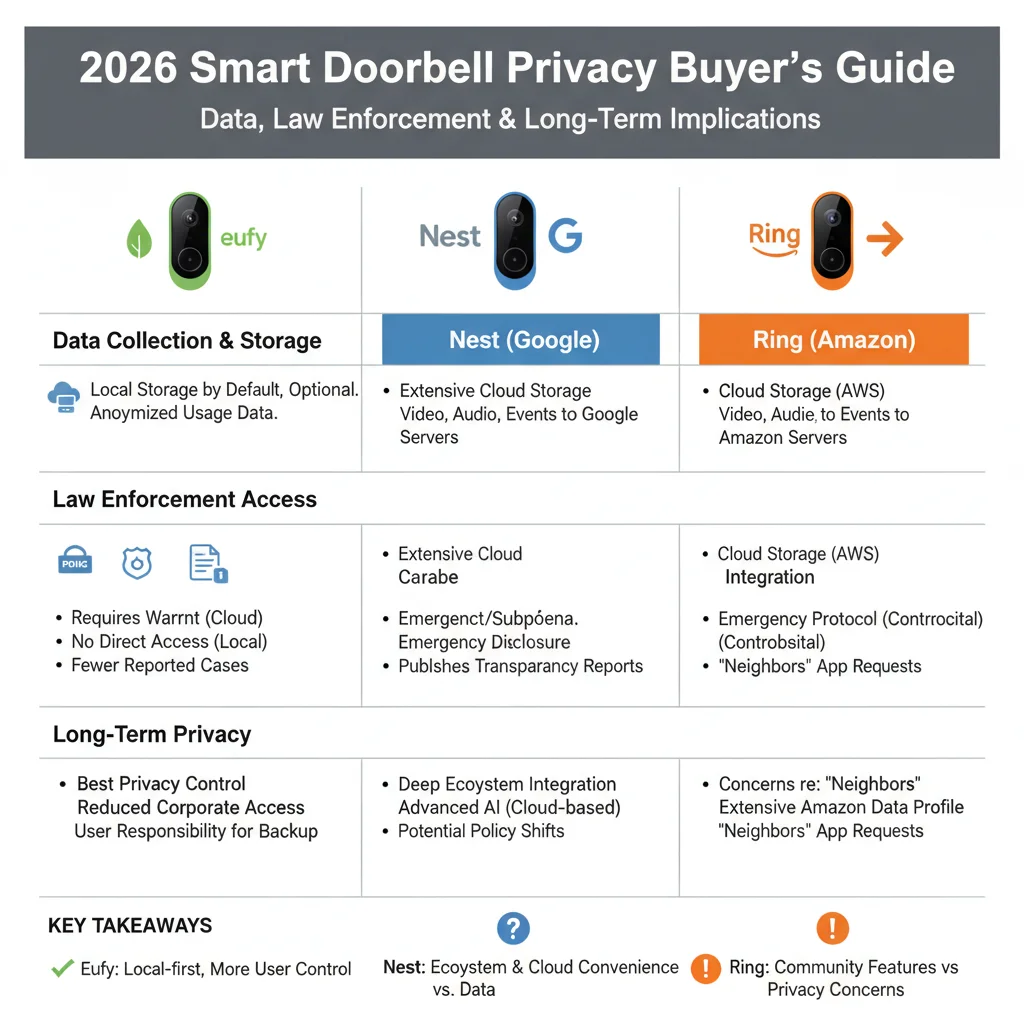
If privacy is your non-negotiable top priority, buy the Eufy. It is currently the only major brand that does not treat your video footage as a data asset. The local storage approach means most of your footage stays on your property rather than on a corporate server.
If you are already deeply in the Google ecosystem and have accepted Google's data collection practices, the Nest is the best of the remaining options. The video quality and intelligent alerts are excellent, and Google's law enforcement policies are stricter than Amazon's.
If you are considering Ring, reconsider. The combination of aggressive data collection, law enforcement partnerships, and a subscription model built around monetizing access to your own footage makes it the worst privacy choice among the major brands.
The honest conclusion is that no commercial video doorbell is truly private. They all record video of your front door and the public space in front of it. The question is which company you trust least with that footage. For most privacy-conscious buyers in 2026, the answer is Eufy — with the understanding that the best privacy decision may be to not install a video doorbell at all if the risks outweigh the benefits for your specific situation.
Frequently Asked Questions
Which video doorbell is actually the most private in 2026?
Eufy was the only major brand in our 12-month test that kept the majority of video and metadata on your local device by default. Ring and Nest send everything to their cloud. If you want to minimize corporate access to footage of your home, Eufy is currently the only reasonable choice among the big brands.
Does Eufy really not share any data with law enforcement?
Eufy has a strong public stance against sharing user video without a warrant and has refused to participate in the kind of broad law enforcement partnerships that Ring has. However, like any company, they would likely comply with a valid court order. The difference is that Eufy does not proactively facilitate easy access the way Ring has in the past.
Is the Google Nest Doorbell a privacy problem if I already use Google services?
It adds another rich data stream to your Google profile. Google will have video of everyone who comes to your door, package delivery patterns, and movement data. If you are already comfortable with Google's data collection practices, Nest may be acceptable. If you are trying to reduce your Google footprint, it is a step in the wrong direction.
Why is Ring the worst choice for privacy?
Ring has the most aggressive data collection, the deepest law enforcement partnerships, and a business model that benefits from keeping your video in their cloud. They have shared user footage with police in ways that other companies have refused, and their subscription model is built around monetizing access to your own security data.
Is there any truly private video doorbell in 2026?
No major brand offers a completely private solution. All of them record video of your front door and the public space in front of it. Eufy is the closest to a privacy-respecting option among the major brands because it minimizes what leaves your property. For maximum privacy, the best choice may be to not install a video doorbell at all.
The video doorbell that will make you happiest from a privacy perspective in 2026 is the one that keeps the most data on your property and shares the least with corporations and governments. Eufy is currently the only major brand that has built its product around that priority. Ring and Nest have business models that depend on extensive data collection and retention. If privacy is your top concern, the choice is clear — and the best choice may be to accept that no commercial video doorbell is truly private and decide whether the security benefit is worth the privacy cost in your specific situation.