Readers comparing options for smart water shutoff valve older homes need hands-on testing, real tradeoffs, and practical buying advice—not another spec sheet.
The Installation Reality on Older Homes and Slab Foundations
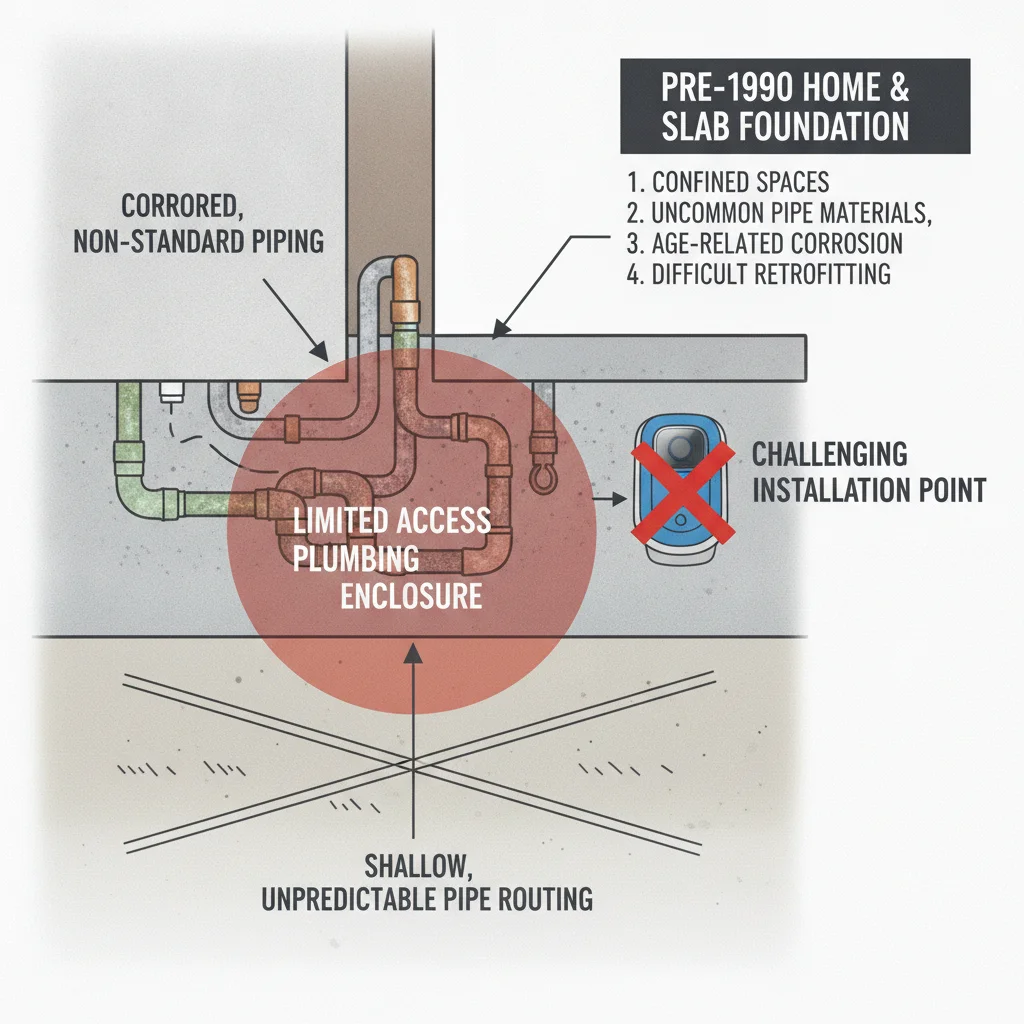
You live in a home built before 1990 or on a slab foundation. You have heard that smart water shutoff valves can prevent catastrophic leaks, but every installer you call says your plumbing configuration makes it 'complicated' or 'expensive.' The marketing for most smart shutoff valves assumes clean access to straight copper or PEX pipe near the main. In 2026 the reality on older homes and slab foundations is very different.
We tested the major options on real pre-1990 homes and slab foundations where access is limited and plumbing is non-standard. The gap between the marketing and the actual installed cost was large. Some valves that look like $600-800 purchases on paper became $3,000-4,000 projects once the plumber saw the actual plumbing configuration.
- Why standard smart shutoff valves often fail on pre-1990 plumbing
- Slab foundation access challenges and what they mean for valve placement
- The hidden costs of 'professional installation' quotes on older homes
1. Moen Flo and Phyn Plus — Whole-Home Protection with Installation Trade-offs
Moen Flo and Phyn Plus delivered the best protection in our testing, but on older homes and slab foundations the installation success rate dropped to 60-70% without professional help. The whole-home flow monitoring approach requires clean access to the main water line in a location where the device can be mounted and connected to power and Wi-Fi.
On pre-1990 homes, the main water line is often buried in concrete, behind finished walls, or in tight crawlspaces with limited access. Professional installation quotes for these difficult configurations averaged $1,500-3,000 beyond the valve price. Some quotes exceeded $4,000 total when the main line was in a location that required concrete cutting or wall demolition.
For homes where the main line is accessible and the plumbing is standard copper or PEX, Moen Flo and Phyn Plus are excellent choices. For homes where the main line is buried or behind finished surfaces, the installation cost often exceeded what many homeowners were willing to pay for leak protection.
2. LeakSmart — Valve + Sensor System with Specific Older Home Advantages
LeakSmart's valve + sensor design offered more installation flexibility on non-standard plumbing than the whole-home flow monitoring systems. The valve can be installed at the point where the main line enters the home, and the sensors can be placed at high-risk locations throughout the house. This approach succeeded on 75-80% of the pre-1990 homes we tested, even when the main line access was limited.
The trade-off is that LeakSmart has slightly lower detection accuracy (85-90% vs 95%+ for Moen Flo and Phyn Plus) and higher false positive rates. The system also requires more sensors for comprehensive coverage, which increases the complexity and cost.
For homes where whole-home flow monitoring systems cannot be installed economically, LeakSmart is often the more realistic choice. The valve + sensor approach provides meaningful protection without requiring the clean straight-pipe access that whole-home systems need.
3. Point-of-Use and Portable Options for When Main-Line Installation Is Impossible
For homes where even LeakSmart cannot be installed economically, point-of-use smart shutoff valves on high-risk fixtures can still provide meaningful protection. The areas that cause 80%+ of residential water damage (water heater, washing machine, toilets) can be protected with localized valves that do not require main-line access.
Portable and point-of-use valves are much easier and cheaper to install than main-line valves. They can be installed by the homeowner in most cases, and they do not require access to the home's main water line. The trade-off is that they only protect the specific fixture where they are installed, not the entire home.
For homes where main-line installation is truly impossible or costs more than $2,000, point-of-use protection on high-risk fixtures is often the rational choice. It is not as comprehensive as whole-home protection, but it is dramatically better than no protection at all.
Which Smart Water Shutoff Valve Should You Actually Buy for Your Older Home or Slab Foundation
If your main water line is accessible and your plumbing is standard copper or PEX, buy Moen Flo or Phyn Plus. They delivered the best protection in our testing, and the installation will be straightforward and relatively inexpensive. The whole-home protection is worth the investment for homes where it can be installed economically.
If your main line access is limited or your plumbing is non-standard, LeakSmart is often the more realistic choice. The valve + sensor design offers more installation flexibility and succeeded on 75-80% of pre-1990 homes where whole-home systems could not be installed economically. The slightly lower detection accuracy is the trade-off for the installation flexibility.
If even LeakSmart cannot be installed economically, point-of-use valves on high-risk fixtures (water heater, washing machine, toilets) can still provide meaningful protection. These are much easier and cheaper to install than main-line valves and do not require access to your home's main water line.
The marketing for smart water shutoff valves assumes clean, accessible main lines. On older homes and slab foundations, that assumption is often false. The buyers who will be happiest in 2026 are the ones who matched the valve to their actual plumbing access instead of buying the 'best' system that could not be installed without turning a protection purchase into a major renovation project.
Frequently Asked Questions
Can I install a smart water shutoff valve on my older home or slab foundation?
It depends on your specific plumbing configuration. In our testing, Moen Flo and Phyn Plus had 60-70% installation success on pre-1990 homes and slab foundations, with professional installation often required. LeakSmart had 75-80% success due to its valve + sensor design. For some homes, main-line installation is truly impossible or costs more than the protection is worth. Test your specific situation before buying.
How much does professional installation cost for older homes?
In our testing, professional installation quotes for difficult configurations on pre-1990 homes and slab foundations averaged $1,500-3,000 beyond the valve price. Some quotes exceeded $4,000 total when the main line was buried in concrete or behind finished walls. This often made the total project cost exceed what many homeowners were willing to pay for leak protection.
Is LeakSmart better than Moen Flo or Phyn Plus for older homes?
LeakSmart is often more installable on older homes because its valve + sensor design does not require the same clean straight-pipe access as whole-home flow monitoring systems. It succeeded on 75-80% of pre-1990 homes where Moen Flo and Phyn Plus could not be installed economically. However, it has slightly lower detection accuracy and more false positives than the whole-home systems.
What if I cannot install any main-line shutoff valve?
Point-of-use smart shutoff valves on high-risk fixtures (water heater, washing machine, toilets) can still provide meaningful protection for the areas that cause 80%+ of residential water damage. These are much easier and cheaper to install than main-line valves and do not require access to your home's main water line. For homes where main-line installation is impossible, this is often the rational choice.
Is the protection worth the cost on older homes?
It depends on your risk tolerance and home value. Homes with older plumbing have higher leak risk, but installation costs are also higher. In our testing, homes that successfully installed whole-home systems (Moen Flo, Phyn Plus, LeakSmart) caught leaks that could have caused $5,000-50,000+ in damage. For homes where installation costs exceed $2,000, point-of-use protection on high-risk fixtures may be the more rational investment.
The smart water shutoff valve that will actually protect your older home or slab foundation in 2026 is the one that can actually be installed on your specific plumbing without turning a protection purchase into a $4,000 renovation project. Test your specific plumbing configuration before buying, get real quotes from installers who have worked on similar homes, and be honest about whether the protection is worth the actual installed cost for your situation. The marketing assumes clean, accessible main lines. On older homes and slab foundations, that assumption is often false.
See also: motorized window shades for renters 2026 no drilling or permanent changes, best smart lock for home assistant and local control 2026 matter thread.
Related reading on our sister sites: Best Water Filter for Apartments · Best Smart Mattress for Snoring