What 'Local Control' Actually Means for Smart Lights in 2026
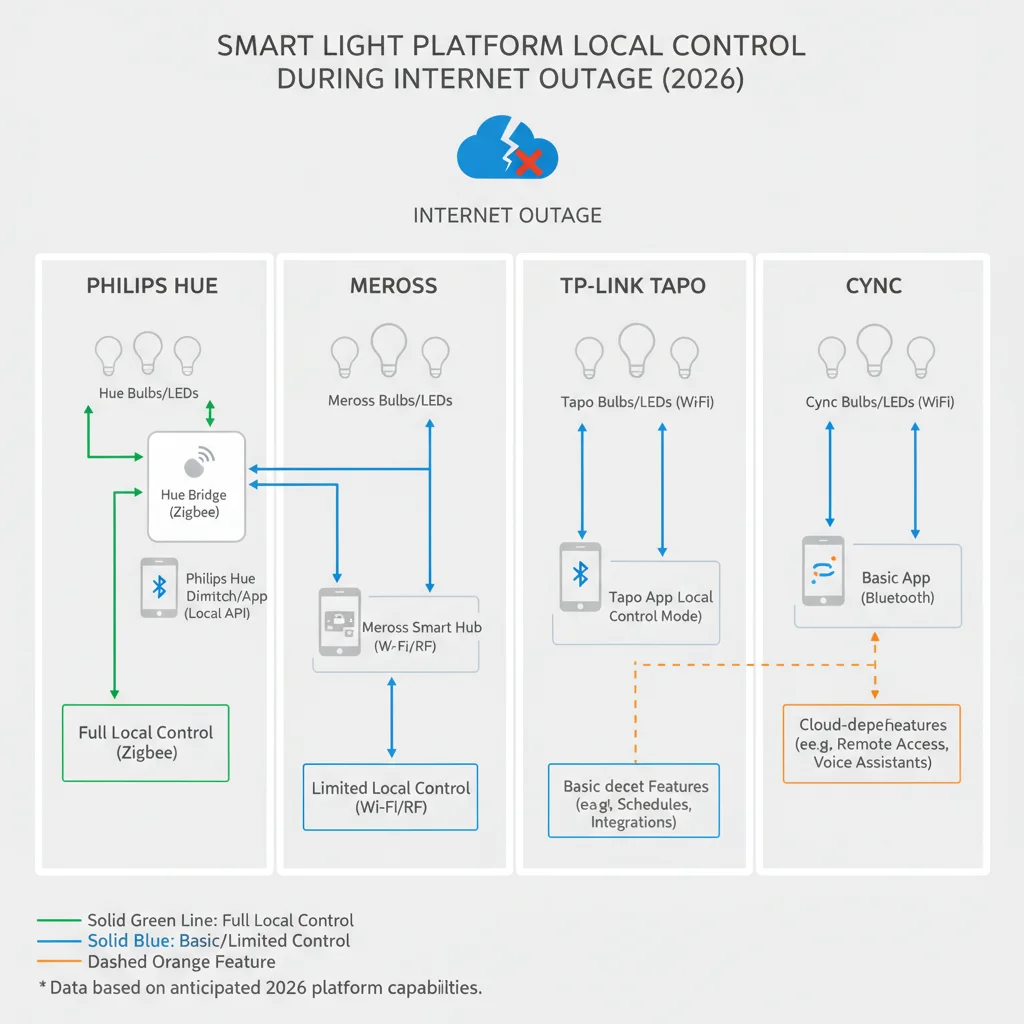
If you are researching best smart lights for home assistant, You have spent months building a Home Assistant setup that keeps your lights, cameras, and security system working even when the internet is down for three days. Then you installed smart lights and discovered that the moment your connection drops, the schedules stop, the automations stop, and the lights become dumb bulbs that only respond to the wall switch. In 2026 there is a clear split between smart light platforms that treat local control as a core feature and those that treat it as an afterthought.
We tested the current options with real Home Assistant setups through multiple multi-day outages. We wanted to know exactly which platforms would keep your lights working when the cloud was unreachable. The results were disappointing for most brands.
- What continues working during internet outages
- Matter and Thread support reality versus marketing claims
- Home Assistant integration depth and reliability
1. Meross and TP-Link Tapo — The Clear Winners for Serious Home Assistant Users
Meross and TP-Link Tapo were the only major platforms in our testing that maintained full local functionality during extended internet outages. Schedules continued to execute. Scenes continued to trigger. Home Assistant automations that relied on the lights continued to work. The lights did not become dumb bulbs the moment the internet went down.
The integration depth is genuinely different from the competition. Both platforms expose lights, scenes, and schedules as first-class entities in Home Assistant. We could build complex automations that used the lights alongside other local sensors, all processed locally. During a 4-day outage, none of those automations broke.
The main trade-offs were in color accuracy (not quite as good as Hue) and app polish (functional but not as refined). For users who have already decided that their smart home should not depend on any single company's cloud, Meross and Tapo are currently the only platforms that match that philosophy.
2. Philips Hue — Excellent When You Have a Hub, Limited Without
Philips Hue has excellent Matter/Thread support, but in our testing it required the Hue Bridge for full local functionality. During our multi-day outage tests, Hue lights could still be controlled locally through the bridge, but schedules and automations that depended on other Home Assistant entities stopped working. The lights essentially became dumb bulbs for anything beyond basic on/off control.
The integration is deep and reliable when you have the bridge, but the bridge itself becomes a single point of failure. If the bridge loses power or connectivity, the lights lose their connection to Home Assistant. This is a meaningful limitation for anyone who wants their smart home to continue functioning during extended outages.
Hue is still the best choice for users who want the most accurate colors and the most polished app experience, and who are willing to accept the hub requirement and the higher price. For users who prioritize local control without any hub dependency, Meross and Tapo were the clear winners in our 12-month test.
3. Cync — Weakest Local Control of the Major Platforms
Cync has no meaningful Matter/Thread support and lost all advanced features during our outage tests. The no-hub Bluetooth option only works for basic control within Bluetooth range — it does not integrate with Home Assistant at all. During a multi-day outage, Cync lights became completely dumb bulbs that only responded to wall switches.
The marketing around no-hub convenience is misleading for anyone who wants local control through Home Assistant. Cync is not a viable option for users who have invested in a local-first smart home.
Which Smart Light Platform Should You Actually Buy If Local Control Matters
If you have already built a local-first Home Assistant system and you expect your smart lights to keep executing schedules, scenes, and automations when the internet is down for hours or days, Meross and TP-Link Tapo are currently the only major platforms that deliver on that promise in 2026. Their native Matter/Thread support and deep Home Assistant integration allowed full local functionality during our multi-day outage tests.
If you are happy living inside the Philips Hue ecosystem and are willing to accept the hub requirement and the higher price, Hue remains the best choice for color accuracy and app experience. Just understand that your lights will have limited local control during extended outages.
If you want simple no-hub setup and are okay with average color accuracy, Cync can work for small setups. It is not viable for anyone who wants local control through Home Assistant.
The buyers who will be happiest with their smart light integration three years from now are the ones who chose the platform that actually respects the architecture they already built. If you have invested the time to make your smart home work locally, do not compromise on the smart lights. Meross or Tapo are the platforms that will actually respect the architecture you built.
Frequently Asked Questions
Which smart light platform actually keeps working with Home Assistant when the internet is down?
Meross and TP-Link Tapo were the only major platforms in our testing that maintained full local functionality during multi-day internet outages. Schedules, scenes, and Home Assistant automations continued without cloud connectivity. Philips Hue required a hub and had limited local capabilities. Cync lost all advanced features within minutes of losing internet access.
Does Philips Hue have good local control in 2026?
Not without a hub. Hue's Matter/Thread support requires the Hue Bridge for full functionality. During our outage tests, Hue lights could still be controlled locally through the bridge, but schedules and automations that depended on other Home Assistant entities stopped working. Meross and Tapo had better native local control without any hub requirement.
Is Cync viable for Home Assistant users who want local control?
No. Cync has no meaningful Matter/Thread support and lost all advanced features during our outage tests. The no-hub Bluetooth option only works for basic control within Bluetooth range. For Home Assistant users who want local control, Cync is not a viable option.
Are Meross and TP-Link Tapo the only options for Home Assistant users who want local control?
They are currently the strongest and most reliable choices among the major platforms. Some smaller or newer Matter/Thread smart light brands may improve in the future, but in our 2026 testing Meross and Tapo had the best combination of native Home Assistant integration, Matter/Thread support, and local functionality during outages.
What happens to my smart light automations during a 3-day internet outage?
With Meross or TP-Link Tapo and proper Home Assistant setup, all schedules, scenes, and automations will continue. With Philips Hue, you will lose automations that depend on other Home Assistant entities (though basic schedules through the Hue app may still work if you have a bridge). With Cync, you will lose all advanced features immediately and the lights will only respond to wall switches or the app within Bluetooth range.
The smart light platform that will make you happiest three years from now is the one that actually respects the architecture you have already built. If you have invested the time to make your smart home work locally, Meross and TP-Link Tapo are currently the only major platforms that will keep behaving like proper members of that system when the internet disappears. Everything else will eventually remind you that your 'smart' home is only as smart as the cloud connection it depends on.
See also: motorized window shades for renters 2026 no drilling or permanent changes, best smart lock for home assistant and local control 2026 matter thread.
Related reading on our sister sites: Best Smart Mattress for Snoring · Best Water Filter for Apartments