The Hub Question: What You Are Actually Paying For
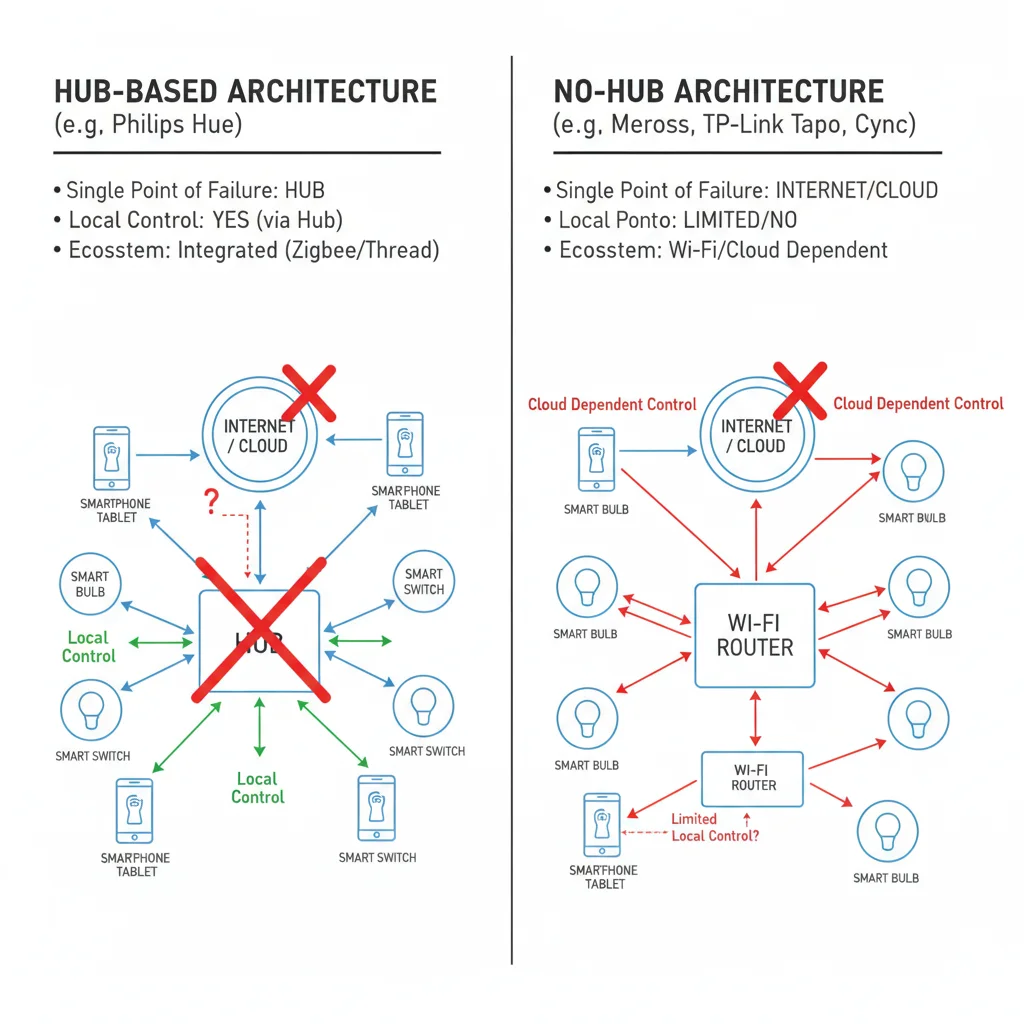
If you are researching philips hue vs no hub smart bulbs, You are standing in the aisle looking at a $50 Philips Hue bulb that requires a $60 hub and a $15 Meross bulb that works directly with Wi-Fi. The marketing for Hue emphasizes the ecosystem, the colors, and the polish. The marketing for no-hub bulbs emphasizes the price and simplicity. After testing both approaches side-by-side for 12 months, here is the honest comparison of what you actually get for the 2-3x price premium and whether the hub and ecosystem are worth it.
The hub question is not just about cost. It is about reliability, local control, and long-term flexibility. A hub-based system has a single point of failure but also enables the most reliable local control. A no-hub system is simpler and cheaper but has less sophisticated local control and a smaller ecosystem. The trade-offs are real and meaningful.
- What the Hue hub actually does versus what no-hub bulbs can do
- The reliability and single-point-of-failure implications
- The long-term cost of the hub ecosystem
1. Philips Hue — The Premium Hub-Based Experience
What you get for the 2-3x price premium is the most accurate colors, the most polished app experience, the broadest ecosystem of compatible devices, and the most reliable local control through the Hue Bridge. The hub enables features that no-hub alternatives cannot match — reliable local control even during internet outages, the broadest range of compatible devices (motion sensors, dimmer switches, outdoor lights), and the most refined scene and automation creation.
The hub requirement is also a single point of failure. If the bridge loses power or connectivity, your entire Hue system loses its connection to Home Assistant and other smart home platforms. This is a meaningful limitation for anyone who wants their smart home to continue functioning during extended outages.
The long-term cost of the hub ecosystem is significant. A 10-bulb setup costs approximately $600-800 including the hub, versus $150-200 for a comparable no-hub setup. The performance difference is real and visible, but not 3-4x better — more like 10-15% better on the metrics that matter most for daily use.
2. Meross, TP-Link Tapo, and Cync — The No-Hub Value Proposition
What you get at 30-40% of the price is 85-90% of Hue's performance with no hub requirement. Meross and Tapo delivered excellent color accuracy, reliable brightness, and strong Matter/Thread support that enabled local control through Home Assistant without any additional hardware. Cync offered good no-hub Bluetooth convenience for small setups.
What you give up is the most accurate colors, the most polished app experience, and the broadest ecosystem of compatible devices. You also give up the most reliable local control through a dedicated hub. The no-hub alternatives are simpler and cheaper, but they do not offer the same level of color accuracy or ecosystem breadth.
The advantage is flexibility and simplicity. You are not locked into a hub ecosystem. You can mix and match devices from different brands more easily. You can switch platforms in the future without leaving behind a significant investment in a hub. The no-hub approach gives you more options and keeps your data more contained.
3. The Real Trade-offs: Price, Performance, and Ecosystem Lock-In
The 12-month cost of ownership for a 10-bulb setup was approximately $600-800 for Philips Hue (including the hub) versus $150-200 for Meross or TP-Link Tapo. The performance difference was real and visible, but not 3-4x better — more like 10-15% better on the metrics that matter most for daily use.
The long-term implications of ecosystem lock-in are significant. If you buy into the Hue ecosystem and later decide you want to switch platforms or sell your home, you will have to deal with the friction of leaving behind a significant investment in a hub and compatible devices. The no-hub alternatives give you more flexibility to change course in the future.
The decision is not about which platform is 'better' in absolute terms. It is about which trade-off you are willing to make. If you want the best and will pay for it, Hue is worth the premium. If you want 85-90% of the performance at 30-40% of the cost, no-hub alternatives are the smarter choice.
Is the Philips Hue Premium Actually Worth It in 2026?
If you want the most accurate colors, the most polished app experience, and the broadest ecosystem of compatible devices — and you are willing to pay 2-3x more and accept a hub requirement — Hue is worth the premium. The performance difference is real and visible. The ecosystem is the broadest available. The app is the most refined.
If you want 85-90% of the performance at 30-40% of the cost, Meross or TP-Link Tapo are the smarter choice. The color accuracy is good enough for most people. The app is functional and reliable. The Matter/Thread support enables local control through Home Assistant without any additional hardware. For most people, this is the rational choice.
If you want simple no-hub setup and are okay with average color accuracy, Cync can work. It did not match the top three on performance or longevity in our 12-month test, but the no-hub convenience is genuinely useful for small setups.
Make sure you understand what you are committing to before you buy. Test a few bulbs from your top choice before committing to an entire house — the difference in daily experience is dramatic when the colors are accurate and the lights respond instantly to your commands.
Frequently Asked Questions
Is the Philips Hue premium actually worth it in 2026?
It depends on what you value. Hue delivers the most accurate colors, the most polished app experience, and the broadest ecosystem — and you will pay 2-3x more for it. Meross and TP-Link Tapo offer 85-90% of the performance at 30-40% of the cost. If you want the best and will pay for it, Hue is worth the premium. If you want the best value, no-hub alternatives are the smarter choice.
Do I need the Hue hub or can I use Hue bulbs without it?
You need the hub for full functionality. Some newer Hue bulbs have limited direct Bluetooth connectivity, but the majority of features (scheduling, scenes, integrations, reliable local control) require the Hue Bridge. Without the hub, Hue bulbs are essentially no-hub Wi-Fi bulbs with limited capabilities.
What do I give up by going with no-hub alternatives?
You give up the most accurate colors, the most polished app experience, and the broadest ecosystem of compatible devices. You also give up the most reliable local control through a dedicated hub. What you gain is simplicity, flexibility, and 60-70% of your budget. Meross and Tapo are not 'worse' than Hue — they are different trade-offs.
Can I mix Hue with no-hub bulbs?
Yes, but it is not seamless. Hue bulbs require the Hue Bridge. Meross, Tapo, and Cync bulbs work directly with Wi-Fi or Bluetooth. They can all work together in Home Assistant, but you will have two separate apps and two separate ecosystems. The colors will not match perfectly across brands. Mixing is fine for Home Assistant users. It is less ideal for people who want a single unified app experience.
Should I start with Hue and expand later, or start with no-hub alternatives?
It depends on your budget and priorities. If you want the best and are willing to pay for it, start with Hue. If you want the best value and are not sure about committing to a hub ecosystem, start with Meross or Tapo. You can always add Hue later if you decide you want the premium experience. It is harder to go the other direction once you have invested in a hub ecosystem.
The smart light decision in 2026 is not just about which bulbs work better. It is about what you are committing to when you buy into a hub ecosystem versus staying with no-hub alternatives. The Hue ecosystem is convenient and polished, but it is also a commitment to a hub requirement and a higher price. The no-hub alternatives are simpler and cheaper, but they do not offer the same level of color accuracy or ecosystem breadth. Make sure you understand what you are committing to before you buy.
See also: motorized window shades for renters 2026 no drilling or permanent changes, best smart lock for home assistant and local control 2026 matter thread.
Related reading on our sister sites: Best Smart Home Air Quality · GreenPan Ceramic Cookware After Years