What Makes Smart Lighting Work for Non-Tech Households
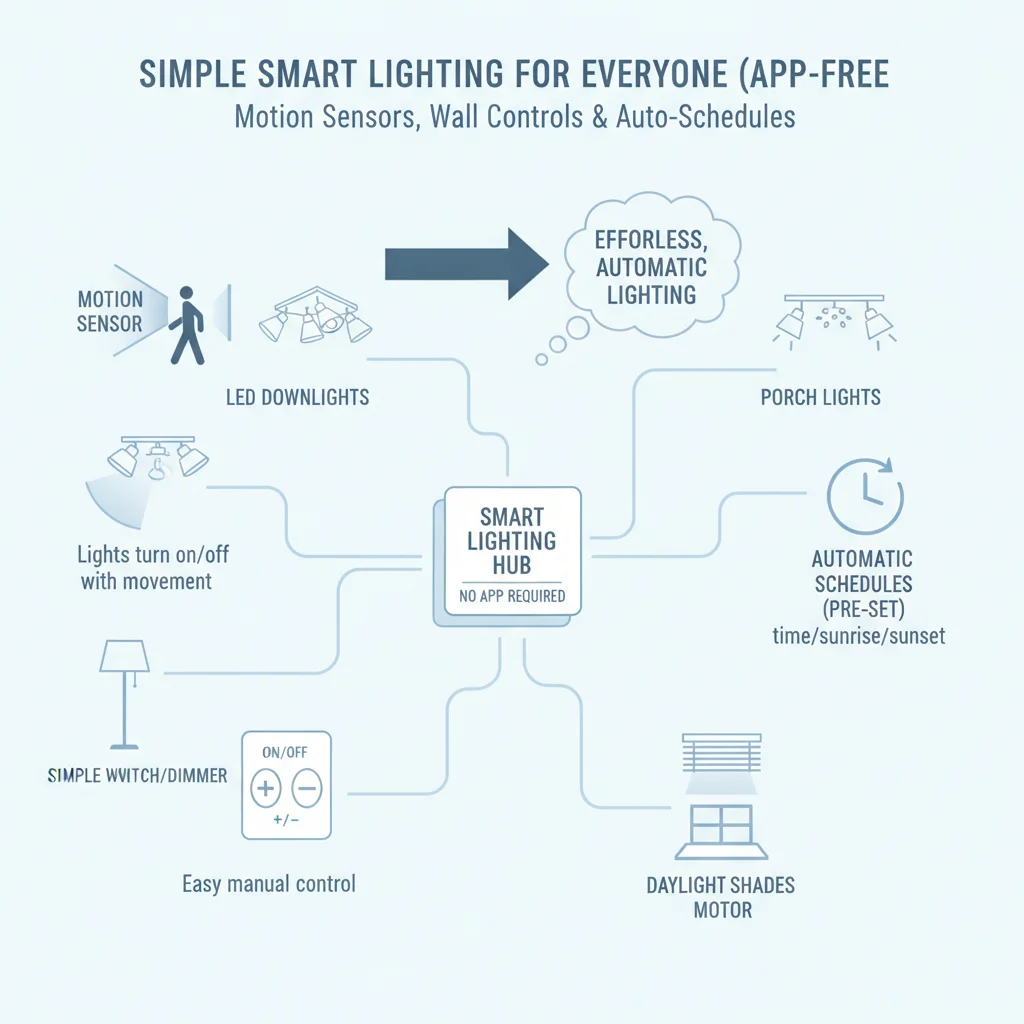
If you are researching smart lighting for non-tech households, You want smart lights that your family can actually use without learning an app or managing schedules. You want lights that turn on when someone walks into a room and turn off when the room is empty. You want lights that dim automatically at night without anyone having to remember to do it. You do not want to be the family IT support person every time someone cannot figure out how to turn on the lights. In 2026 all four major smart light platforms claim to offer simple, family-friendly setups. We tested them in homes with non-tech users and multiple family members over 12 months. The gap between the marketing and the reality was large.
What actually works for non-tech households is not what the marketing emphasizes. The most successful setups in our testing used motion sensors for automatic on/off, simple wall-mounted dimmers for manual control, and automatic schedules that required no daily interaction. The platforms that required app or voice assistant interaction for basic use failed for non-tech users within the first month.
- Motion detection and automatic on/off that actually works
- Simple controls that do not require an app or voice assistant
- Multi-user scenarios where different people have different preferences
1. Philips Hue — Most Flexible but Requires Tech-Savvy Setup
Philips Hue offered the most flexible setup for multi-user homes with different preferences and schedules. You could create individual profiles, set different preferences for different rooms, and customize almost every aspect of the lighting experience. The ecosystem of motion sensors, dimmer switches, and other compatible devices was the broadest available.
The problem was that the initial setup and ongoing management required a tech-savvy person. Creating profiles, setting up automations, and troubleshooting issues required comfort with apps and smart home concepts. In households with no tech-savvy person, Hue setups often fell into disuse within the first month because no one knew how to fix problems or adjust settings.
For households with at least one tech-savvy person who could set up and manage the system, Hue offered the most flexible and capable smart lighting experience. For households with no tech-savvy person, Hue was not the right choice.
2. Meross and TP-Link Tapo — Good Balance of Features and Simplicity
Meross and TP-Link Tapo offered a good balance of features and simplicity for non-tech households. The apps were functional and intuitive enough that most users could figure out basic controls without extensive training. Motion sensors worked reliably for automatic on/off. Automatic schedules could be set up once and then left alone.
The multi-user support was adequate for most families. Different users could have different preferences, and the system could handle multiple people in the same home without constant conflicts. The apps were simple enough that most family members could adjust basic settings without needing tech support.
For households with moderate tech comfort, Meross and Tapo offered the best balance of features and simplicity. The systems worked reliably without requiring constant management, and most family members could figure out the basics without extensive training.
3. Cync — Simplest Setup but Limited Features
Cync offered the simplest no-hub setup of any platform we tested. The Bluetooth connectivity meant no hub was required, and the app was straightforward for basic controls. For households with minimal tech comfort, this simplicity was genuinely valuable.
The trade-off was limited automation and multi-user capabilities. Cync did not have the sophisticated motion detection or multi-user profile features that Hue, Meross, and Tapo offered. The no-hub Bluetooth approach also meant that the system only worked within Bluetooth range — it did not integrate well with other smart home platforms or work reliably across a large house.
For households with minimal tech comfort who only need basic on/off and dimming controls, Cync offered the simplest setup. For households that wanted automatic features or multi-user support, Cync was not the right choice.
Which Smart Lighting Platform Should You Actually Choose for Your Non-Tech Household
If your household has no tech-savvy person and you only need basic on/off and dimming controls, Cync offers the simplest setup. The no-hub Bluetooth approach requires minimal configuration, and the app is straightforward for basic use. Just be aware that you are giving up automation and multi-user features.
If your household has moderate tech comfort and you want a good balance of features and simplicity, Meross or TP-Link Tapo offer the best option. The apps are functional and intuitive enough for most users, motion sensors work reliably for automatic on/off, and the systems can handle multi-user scenarios without constant management.
If your household has at least one tech-savvy person who can set up and manage the system, Philips Hue offers the most flexible and capable smart lighting experience. The ecosystem is the broadest, the multi-user support is the most sophisticated, and the automation capabilities are the most advanced. Just be prepared for the initial setup and ongoing management to require tech-savvy attention.
Do not buy any smart lighting expecting it to be completely hands-off for a non-tech household. All of them require some initial configuration and occasional troubleshooting. The ones that require daily app interaction or complex setup are the ones to avoid if your household is not tech-savvy. Test a few bulbs and sensors from your top choice in your actual home before committing to an entire house — the difference in daily experience is dramatic when the lights actually work without anyone having to think about them.
Frequently Asked Questions
Which smart lighting platform actually works for non-tech households?
It depends on your household's tech comfort level. Philips Hue works for households with at least one tech-savvy person who can set it up and manage it. Meross and TP-Link Tapo work for households with moderate tech comfort. Cync works for households with minimal tech comfort but has limited automation capabilities. The key is matching the platform to your actual tech comfort level.
Do I need to be tech-savvy to use smart lights?
Not necessarily, but you need to choose the right platform. Cync offers the simplest no-hub setup with minimal app interaction. Meross and Tapo offer a good balance of features and simplicity. Hue requires more tech-savvy setup and management. The key is choosing a platform that matches your household's actual tech comfort level.
How do I set up smart lights for multiple family members with different preferences?
Philips Hue offers the most flexible multi-user setup with individual profiles and preferences. Meross and Tapo offer good multi-user support through their apps. Cync has limited multi-user capabilities. The key is choosing a platform that allows different users to have different preferences without requiring constant management.
What features actually work for non-tech users?
Motion sensors for automatic on/off, simple wall-mounted dimmers for manual control, and automatic schedules that require no daily interaction. Features that require app interaction, voice commands, or complex setup do not work well for non-tech users. The most successful setups in our testing were the ones that required the least daily interaction.
Should I buy smart lights if my household is not tech-savvy?
Only if you choose the right platform and set it up correctly. Cync offers the simplest setup for minimal tech comfort households. Meross and Tapo offer a good balance for moderate tech comfort. Hue requires more tech-savvy setup. If your household has no tech comfort at all, you may be better off with traditional lighting and simple timers rather than smart lights.
The smart lighting that will make you happiest in a non-tech household in 2026 is the one that requires the least daily interaction. Motion sensors for automatic on/off, simple wall-mounted dimmers for manual control, and automatic schedules that require no daily management. Choose the platform that matches your household's actual tech comfort level, and test a few bulbs and sensors in your actual home before committing to an entire house. The difference in daily experience is dramatic when the lights actually work without anyone having to think about them.
See also: motorized window shades for renters 2026 no drilling or permanent changes, best smart lock for home assistant and local control 2026 matter thread.
Related reading on our sister sites: Best Smart Mattress for Snoring · Best Non-Stick Pan for High