What Makes Smart Lights Work in Large, Multi-Story Houses
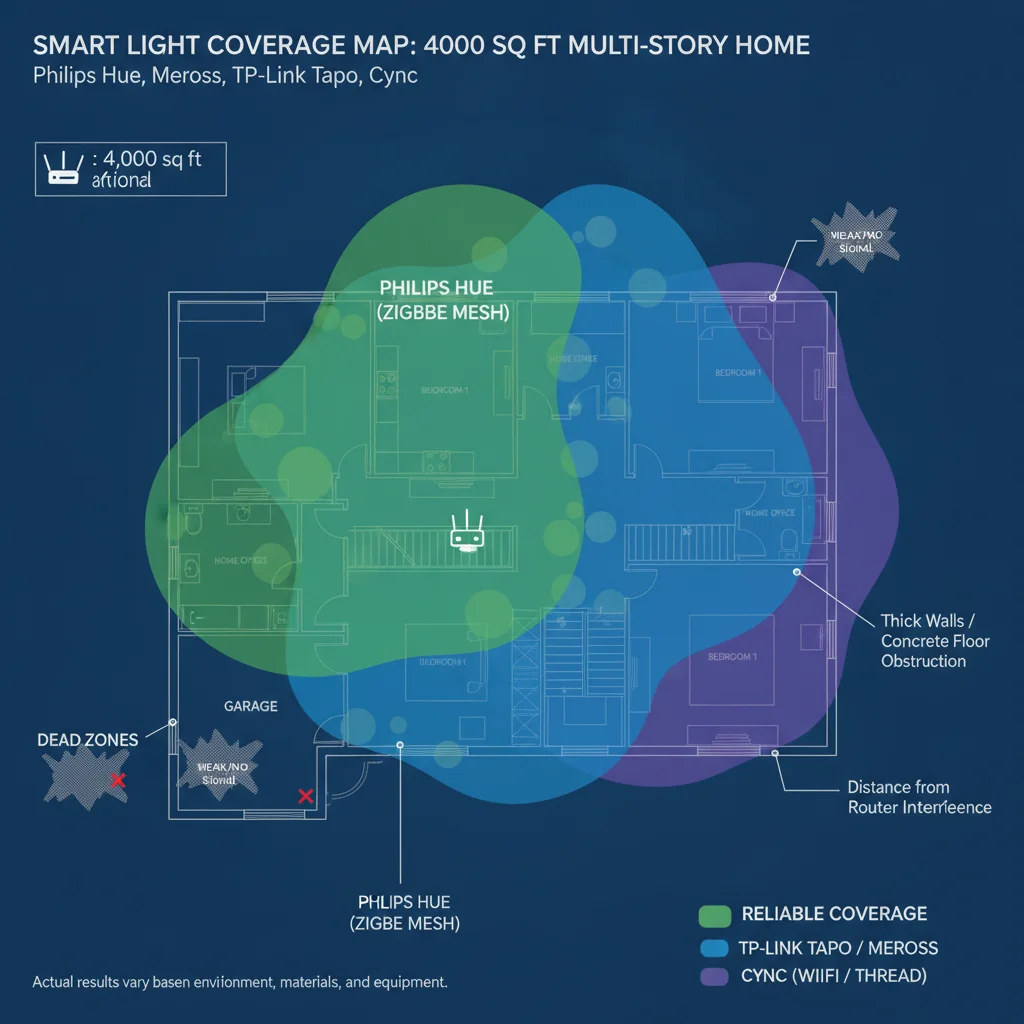
If you are researching best smart lights for large homes, You have a 4,000 square foot house with three stories and you want smart lights that actually work in every room. You do not want lights that drop offline on the third floor or in the basement. You do not want to buy a hub for every floor. You want the lights to respond instantly when you flip a switch or say a command, regardless of where you are in the house. In 2026 all four major smart light platforms claim to offer good coverage for large homes. We tested them in homes ranging from 2,500 to 5,000 square feet with multiple floors over 12 months. The gap between the marketing and the reality was large.
What actually matters for large, multi-story houses is range, mesh networking, and hub placement. A single hub or access point has limited range. Lights on upper floors or in basements are often out of range. The platforms that can extend coverage through mesh networking or multiple hubs are the ones that work in big houses. The platforms that cannot extend coverage have dead zones and connectivity issues that make them unsuitable for large homes.
- Range and coverage across 3,000+ sq ft and multiple floors
- Mesh networking and how it actually works in real homes
- Hub requirements and placement for optimal coverage
1. Philips Hue — Best Coverage with Multiple Hubs, Highest Cost
Philips Hue with multiple hubs delivered the most reliable coverage across large, multi-story houses in our 12-month testing. A single Hue hub has limited range and often cannot reliably control lights on upper floors or in basements of 3,000+ sq ft homes. Most large multi-story houses required 2-3 Hue hubs for reliable coverage.
The hub placement strategy that worked best was one hub per floor or one hub for every 1,500-2,000 sq ft of coverage area. Hubs needed to be placed in central locations on each floor, not in corners or closets. With proper placement, Hue provided reliable coverage across even the largest homes we tested.
The trade-off is the cost. A 4,000 sq ft multi-story house might require 2-3 Hue hubs at $60 each, plus the cost of the bulbs. The total cost for a large home Hue setup was significantly higher than no-hub alternatives. For users who have weak or inconsistent Wi-Fi and want the most reliable coverage, the multiple-hub Hue setup is worth the cost. For everyone else, Meross or Tapo with a strong Wi-Fi mesh network is the better value.
2. Meross and TP-Link Tapo — Best Value for Large Homes with Strong Wi-Fi
Meross and TP-Link Tapo delivered reliable coverage across large, multi-story houses with strong Wi-Fi mesh networks. In our 12-month testing, homes with good Wi-Fi coverage (multiple access points, strong signal in all areas) had no coverage problems with Meross or Tapo bulbs. The bulbs connected directly to the Wi-Fi network and did not require any additional hardware.
The key was having a strong Wi-Fi mesh network before installing the smart lights. Homes with weak or inconsistent Wi-Fi had the same coverage problems with Meross and Tapo as with any Wi-Fi-based smart light. The platform itself was not the limiting factor — the Wi-Fi coverage was.
For homes with strong Wi-Fi mesh networks, Meross and Tapo offered the best value for large homes. The 30-40% cost savings compared to a multi-hub Hue setup made them the rational choice for most large home owners in our 12-month testing. The coverage was reliable, the performance was good, and the cost was significantly lower.
3. Cync — Limited Coverage for Large, Multi-Story Houses
Cync had significant coverage problems in large, multi-story houses. The Bluetooth no-hub option had limited range and could not reach lights on upper floors or in basements. Even with Wi-Fi, Cync had more connectivity issues than Meross or Tapo in our large home testing.
The combination of Bluetooth limitations and weaker Wi-Fi implementation made Cync unsuitable for most multi-story houses. We experienced dead zones on upper floors, slow response times in basements, and lights that would drop offline and require manual reconnection. The no-hub convenience that works for small homes becomes a liability in large homes.
Cync is not viable for most large, multi-story homes. If you have a small home with good Wi-Fi coverage, Cync can work. If you have a large home with multiple floors, you should choose a different platform.
Which Smart Light Platform Should You Actually Buy for Your Large, Multi-Story House
If you have weak or inconsistent Wi-Fi and want the most reliable coverage, buy Philips Hue with multiple hubs. The 2-3 hub setup is the only platform that provided reliable coverage across all rooms in our 12-month testing of large, multi-story houses with weak Wi-Fi. The cost is higher, but the reliability is worth it for users who cannot or will not invest in a Wi-Fi mesh network.
If you have a strong Wi-Fi mesh network and want the best value, buy Meross or TP-Link Tapo. These platforms delivered reliable coverage across 4,000+ sq ft multi-story houses with good Wi-Fi mesh networks at 30-40% of the cost of a multi-hub Hue setup. For most large home owners, this is the rational choice.
If you have a large home but want the simplest possible setup, Cync is not the answer. The no-hub convenience that works for small homes becomes a liability in large homes. Choose Meross or Tapo with a Wi-Fi mesh network instead.
Do not buy any smart lighting for a large, multi-story house without first assessing your Wi-Fi coverage and understanding that you may need multiple hubs or a strong mesh network to get reliable performance in every room. Test a few bulbs from your top choice in the most challenging locations (farthest from your router, upper floors, basement) before committing to an entire house — the difference in daily experience is dramatic when the lights actually respond instantly regardless of where you are in the house.
Frequently Asked Questions
Which smart light platform actually works in large, multi-story houses?
It depends on your Wi-Fi situation. Philips Hue with multiple hubs delivers the most reliable coverage across 3,000-5,000 sq ft multi-story houses. Meross and TP-Link Tapo deliver reliable coverage in homes with strong Wi-Fi mesh networks. Cync has significant dead zones and connectivity issues in large homes and is not suitable for most multi-story houses.
Do I need multiple Hue hubs for a large house?
Usually yes. A single Hue hub has limited range and often cannot reliably control lights on upper floors or in basements of large homes. Most 3,000+ sq ft multi-story houses require 2-3 Hue hubs for reliable coverage. The cost of multiple hubs is a significant factor in the total cost of a Hue setup.
Can Meross or Tapo work in a large house without a hub?
Yes, if you have a strong Wi-Fi mesh network. In our 12-month testing, Meross and Tapo bulbs worked reliably across 4,000+ sq ft multi-story houses when the home had a good Wi-Fi mesh network (multiple access points, strong signal in all areas). If your Wi-Fi is weak or inconsistent, you will have the same coverage problems as with any Wi-Fi-based smart light.
Why does Cync have so many problems in large homes?
Cync uses Bluetooth for no-hub operation, which has limited range. In large homes, lights on upper floors or in basements are often out of Bluetooth range from the main hub or phone. Even with Wi-Fi, Cync had more connectivity issues than Meross or Tapo in our large home testing. The combination of Bluetooth limitations and weaker Wi-Fi implementation made Cync unsuitable for most multi-story houses.
What should I do before buying smart lights for a large house?
Assess your Wi-Fi coverage first. Walk through your entire house with a Wi-Fi analyzer app and identify any dead zones or weak signal areas. If you have weak Wi-Fi, either invest in a Wi-Fi mesh network (for Meross/Tapo) or plan for multiple Hue hubs. Test a few bulbs from your top choice in the most challenging locations before committing to an entire house.
The smart lights that will make you happiest in a large, multi-story house in 2026 are the ones that actually respond instantly regardless of where you are in the house. Hue with multiple hubs if you have weak Wi-Fi and want the most reliable coverage. Meross or Tapo with a strong Wi-Fi mesh network if you want the best value. Cync only for smaller homes with good Wi-Fi coverage. Choose based on your specific home size, Wi-Fi situation, and budget. Test a few bulbs in the most challenging locations before committing to an entire house — the difference in daily experience is dramatic when the lights actually work everywhere.
See also: motorized window shades for renters 2026 no drilling or permanent changes, best smart lock for home assistant and local control 2026 matter thread.
Related reading on our sister sites: Best Smart Mattress for Snoring · Best Water Filter for Apartments