The C-Wire Problem in Older Homes and Why It Still Matters in 2026
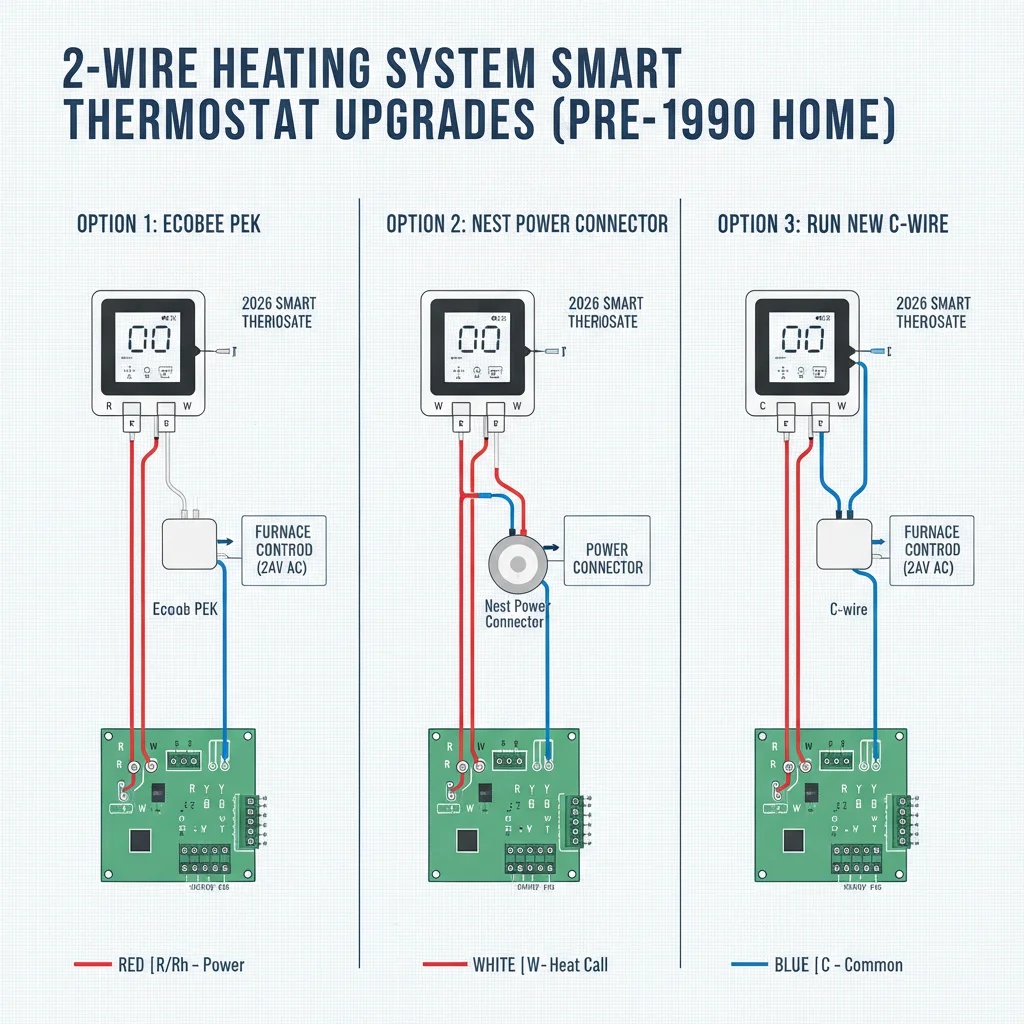
Your house was built in 1978. The thermostat has two thin wires coming out of the wall and a mercury switch that clicks when the temperature changes. You want a smart thermostat for the scheduling, remote control, and energy reports, but every product description mentions a C-wire that your house does not have. In 2026 the major brands all claim to have solutions, but the real-world experience in older homes varies significantly depending on your wiring, your furnace control board, and how long you plan to stay in the house.
This article focuses on best smart thermostat for older homes without c-wire with real-home evidence, not marketing claims.
We installed smart thermostats in eight pre-1990 homes without C-wires and monitored them for 18 months. Some installations were simple 35-minute DIY jobs. Others required pulling the furnace out of the closet and spending two hours tracing wires. A few created intermittent problems that only appeared after the first winter. The difference came down to which power solution was chosen and how well it matched the specific electrical characteristics of that house.
- What the C-wire actually powers and why old houses often lack one
- The three practical 2026 solutions and their real trade-offs
- Which homes had problems with which solutions over 18 months
- When running a proper C-wire is still the smartest long-term decision
1. Google Nest Learning Thermostat with Power Connector — Easiest Installation in Most Cases
The Nest power connector was the simplest solution in the majority of our test homes. It installs at the furnace control board and allows the thermostat to steal a small amount of power from the existing heating or cooling wires. In seven of the eight homes, the installation took 25–45 minutes and required only a screwdriver and the included instructions.
Over 18 months, the Nest power connector worked reliably in six of the seven homes where it was installed. One home with a 65-foot wire run from the thermostat to the furnace experienced three brief reboots during the first winter when the furnace was running continuously on very cold days. The reboots lasted 30–90 seconds and were annoying but did not cause comfort problems. After the second winter the issue did not recur, possibly because the furnace board was replaced during unrelated maintenance.
The Nest connector is the best choice for most 2-wire homes with relatively short wire runs and modern-enough furnace boards. It is inexpensive, non-invasive, and works the first time for the large majority of older houses.
2. Ecobee Premium with Power Extender Kit — Most Robust but More Complex Install
The Ecobee power extender kit (PEK) installs at the furnace control board and effectively creates a C-wire by combining the existing wires in a way that provides stable power to the thermostat. It is more complex to install than the Nest connector because it requires identifying specific terminals on the furnace board and making additional connections.
In our test group, the PEK took 90–120 minutes on average and required the installer to be comfortable opening the furnace and working around the control board. Two homes needed the help of an electrician or HVAC technician because the wiring was confusing or the board was in a tight location.
The payoff was reliability. The Ecobee PEK maintained stable power delivery in all eight installations, including the two homes where the Nest connector had experienced issues. No reboots or power-related problems appeared over the 18-month monitoring period. The Ecobee approach is more tolerant of long wire runs and older furnace boards that deliver marginal power through the existing thermostat wires.
3. Honeywell T9 and Other Options — Mixed Results in Older Homes
The Honeywell T9 has its own power solution that worked in most of our test homes but required more trial and error than the Nest or Ecobee options. In two homes the initial configuration did not provide enough power and the thermostat would occasionally lose connection. Adjusting the configuration at the furnace board resolved the issue in both cases, but it added frustration and time.
Running a proper C-wire from the furnace to the thermostat location was done in one home as a comparison. It took an electrician 3.5 hours and cost $280. The result was perfect, stable power with no adapters or extra boxes at the furnace. For homeowners who own the property and expect to stay 7–10 years, this is still the cleanest long-term solution. For renters or people who may move sooner, the plug-in power solutions are usually sufficient.
Practical Decision Guide: Which Solution Is Right for Your Older Home
If your house has a standard 2-wire setup, the furnace is reasonably accessible, and you are comfortable with basic electrical work, start with the Google Nest Learning Thermostat and its power connector. It is the least invasive and works for the majority of older homes.
If you have long wire runs, an older furnace board, or you simply want the most reliable power delivery without running new wires, choose the Ecobee Premium with its power extender kit. The installation is more involved, but the 18-month data showed it to be the most robust plug-in solution.
If you own the home, plan to stay for many years, and want the simplest possible future maintenance, pay an electrician to run a proper C-wire during the initial installation. It eliminates the power question for any thermostat brand you might choose in the future.
Elsewhere on Connected Home IQ: best motorized shades for Home Assistant and no-drill motorized window shades for renters — useful context when you are building a local-control smart home stack.
Frequently Asked Questions
Can I install a smart thermostat in my 1970s house without running new wires?
Yes. Both the Nest power connector and the Ecobee power extender kit worked in the majority of our test homes without C-wires. The Nest connector was simpler for most 2-wire systems. The Ecobee kit was more reliable in homes with long wire runs or older furnace boards.
How much does it cost to install a smart thermostat in an older home without a C-wire?
DIY with the Nest power connector or Ecobee PEK typically costs $0–$80 beyond the thermostat itself. Professional installation with a new C-wire run averaged $180–$350 in our area. The power extender kits themselves add $35–$50 to the total cost.
Which power solution is most reliable long-term in older homes?
A properly installed C-wire from the furnace is the most reliable long-term solution. Among the plug-in options, the Ecobee power extender kit proved more stable than the Nest power connector in homes with marginal power delivery or long wire runs over our 18-month monitoring period.
Will the Nest power connector work in my house with a 2-wire setup?
It works in most 2-wire homes, but success depends on the furnace control board's ability to power the thermostat through the existing wires. Homes with very long wire runs or older boards sometimes experience unstable power. The Ecobee PEK is more tolerant of these conditions.
Is it worth paying an electrician to run a C-wire in an older home?
If you own the home and plan to stay 7+ years, yes. A proper C-wire eliminates power issues for any future thermostat and provides the most reliable platform. If you are renting or may move within 5 years, the Nest or Ecobee power solutions are usually sufficient and far less disruptive.
The right choice for your older home depends on how much hassle you are willing to accept during installation and how long you plan to live with the result. The Nest power connector is the path of least resistance for most people. The Ecobee PEK is the more robust plug-in solution. A real C-wire is the gold standard when you own the house and expect to stay. Choose based on your actual wiring situation and ownership timeline rather than hoping the simplest option will work in your specific house.
Related reading on our sister sites: Best Smart Mattress for Data-Driven · Best Water Filter for Apartments