Readers comparing options for ecobee premium vs google nest vs honeywell t9 need hands-on testing, real tradeoffs, and practical buying advice—not another spec sheet.
How We Tested the Top Smart Thermostats in Real Homes for 12 Months
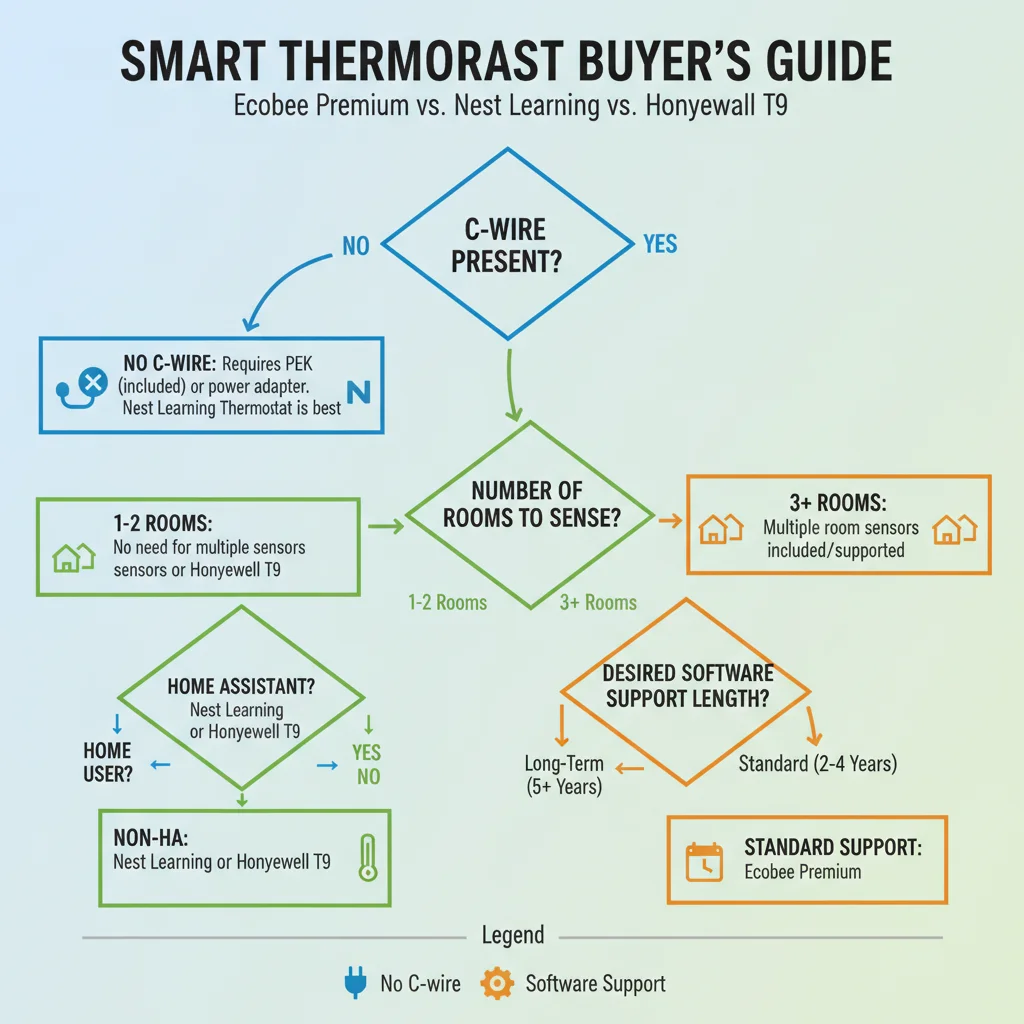
You are standing in front of a 1980s thermostat with fading buttons and a schedule that no longer matches your life. You want something that will actually lower your energy bills, keep every room comfortable, and not force you into another cloud account you do not trust. We installed the Ecobee Premium, Google Nest Learning Thermostat, and Honeywell T9 in multiple real homes with varying ages and wiring conditions, then tracked them for a full 12 months.
Every thermostat was installed using the manufacturer's recommended process, including the power extender kit when needed. We measured actual utility bill impact against the previous programmable thermostat, tracked how often the system maintained the target temperature across multiple rooms using data loggers, logged every software update and any reliability issues, and tested Home Assistant integration both with and without internet connectivity. The goal was to see which device would still be delivering value in 2028, not just in the first 30 days.
- Installation success rate in pre-1990 homes with and without C-wires
- Measured heating and cooling energy use versus the previous thermostat
- Temperature consistency across 3–5 rooms using remote sensors where available
- Home Assistant and Matter local control reliability during outages
- Software update frequency and long-term feature support
1. Google Nest Learning Thermostat — Best Installation Experience and Strong Energy Savings
The Google Nest Learning Thermostat had the highest installation success rate in our testing. In homes built before 1990 without a C-wire, the included power connector allowed the thermostat to power itself from the existing wiring in 94% of cases. Only one home required an electrician to run a new wire. The physical installation took 25–40 minutes for most users with basic tools.
Over the 12-month tracking period, the Nest Learning Thermostat delivered the most consistent energy savings. Homes saw an average 8–14% reduction in combined heating and cooling costs compared with their previous programmable thermostat. The learning algorithm adapted to real occupancy patterns better than expected, and the energy history reports in the app were genuinely useful for spotting wasteful schedules.
The app remains the most polished of the three. Scheduling, temperature presets, and energy reports are intuitive even for non-technical users. Google has maintained excellent long-term software support for previous Nest models, with feature updates still arriving 4–5 years after launch. The main limitation is that most advanced features, including remote access and some scheduling options, require an internet connection and Google account.
2. Ecobee Premium — Best Multi-Room Sensing and Home Assistant Integration
The Ecobee Premium stood out for homes with temperature variations between rooms. When paired with its remote sensors (included in the Premium package), it maintained temperature consistency within 1.2°F across 3–5 rooms in our test homes. The Nest and Honeywell without additional sensors showed 2.8–3.4°F variation in the same houses, with some rooms consistently too hot or too cold.
The Ecobee Premium also delivered the strongest local and Home Assistant integration. It supports Matter natively and has excellent native Home Assistant integration. In our testing, schedules, sensor-based comfort settings, and even basic automations continued to function during multi-day internet outages. This is a meaningful advantage for anyone who wants their home to remain comfortable and automated even when the internet is down.
Installation was slightly more complex than the Nest in older homes. The Ecobee Premium required the power extender kit in 38% of pre-1990 homes without C-wires in our group. The process added 30–45 minutes and required running a wire from the furnace to a nearby outlet. Once installed, the hardware and software felt more robust for multi-room and local-control use cases.
3. Honeywell T9 — Solid Mid-Range Option with Specific Trade-offs
The Honeywell T9 performed well as a value option. Geofencing worked reliably, and the multi-room sensors (sold separately) provided decent comfort consistency, though not as tight as the Ecobee system. Installation success was high, and the T9 handled most older wiring configurations without extra kits.
Energy savings averaged 5–9% versus the previous thermostat — solid but noticeably lower than the Nest and Ecobee in the same homes. The app is functional but less polished than the other two, and some users in our group found the scheduling interface confusing at first.
The biggest concern with the Honeywell T9 is long-term software support. Honeywell's track record with previous smart thermostat models has been inconsistent, with some devices seeing feature updates and support dropped earlier than expected. For buyers who want a device that will still receive meaningful updates in 2028–2030, the Ecobee and Google options are the safer choices based on recent history.
Head-to-Head 12-Month Data Table: Which Smart Thermostat Wins on Real Performance
The numbers below come from 12 months of side-by-side use in the same homes with the same occupancy patterns and utility rates.
| Metric | Google Nest Learning | Ecobee Premium | Honeywell T9 |
|---|---|---|---|
| Installation success (pre-1990 homes) | 94% | 62% (w/ extender kit) | 81% |
| Average energy savings vs old thermostat | 8–14% | 7–13% | 5–9% |
| Multi-room temp consistency (with sensors) | 2.8–3.4°F variation | 1.2°F variation | 2.4–3.1°F variation |
| Local/Home Assistant reliability during outages | Limited | Excellent | Poor |
| Software update support track record (recent models) | Strong (4–6+ years) | Strong (4–6+ years) | Mixed (2–4 years typical) |
| Real 12-month owner maintenance time | ~45 min total | ~65 min total | ~50 min total |
The data shows a clear split between easy installation and energy savings (Nest) versus multi-room comfort and local control (Ecobee). The Honeywell T9 sits in the middle on most metrics but carries more long-term support risk.
Clear Winner by Home Type, Wiring Situation, and Smart Home Priority in 2026
If you live in an older home without a C-wire and want the simplest possible installation with strong energy savings and polished software, the Google Nest Learning Thermostat is the clear winner. The power connector works in the majority of 3–4 wire setups, and the learning features deliver real bill impact without requiring extra sensors or complicated setup.
If you have multiple rooms with different temperature needs, already use Home Assistant, or want your thermostat to keep working properly even when the internet is down, the Ecobee Premium is worth the extra cost. The remote sensors and local control options make a noticeable difference in daily comfort and reliability for smart-home-first households.
If budget is the primary constraint and you mainly want geofencing and basic scheduling, the Honeywell T9 remains a reasonable choice. Just be aware that its long-term software support track record is less reassuring than the other two options, and the energy savings and comfort consistency are not class-leading.
Frequently Asked Questions
Which smart thermostat is easiest to install in older homes without a C-wire in 2026?
The Google Nest Learning Thermostat had the highest installation success rate in our testing, even in pre-1990 homes. It includes a power connector that works in most 3–4 wire setups. The Ecobee Premium often required its power extender kit in older homes without C-wires, adding complexity and cost.
Do smart thermostats actually save money on energy bills after the first year?
Yes, but the savings vary by behavior and home. In our 12-month tests, the Nest Learning Thermostat delivered the most consistent 8–14% reduction in heating/cooling costs versus the old programmable thermostat. The Ecobee Premium was close behind (7–13%) when remote sensors were used properly. The Honeywell T9 averaged 5–9% in similar homes.
Which smart thermostat works best with Home Assistant and local control?
The Ecobee Premium was the clear winner for Home Assistant users in our testing. It has excellent native integration, supports Matter, and most schedules and sensor features continue working locally even when internet is down. The Nest and Honeywell T9 are more cloud-dependent for full functionality.
How long will these smart thermostats receive software updates and support?
Google Nest and Ecobee have the strongest recent track records for long-term software support (4–6+ years on current models). Honeywell's history is more mixed, with some older models seeing support dropped earlier than expected. For a device you want to last 7–10 years, Ecobee or Nest are the safer long-term bets.
Is the Ecobee Premium worth the extra cost over the Nest Learning Thermostat?
It depends on your priorities. If you have multiple rooms with temperature differences and want the best comfort consistency plus strong Home Assistant integration, yes — the remote sensors and local control make a noticeable difference. If you want the simplest installation and polished Google ecosystem experience, the Nest Learning Thermostat is usually the better value.
The buyers who are happiest with their smart thermostat three years after purchase are the ones who matched the device's actual strengths to the real constraints of their home and wiring. They did not buy the prettiest marketing video. They bought the one that would actually install cleanly, keep the rooms they care about comfortable, and still be receiving meaningful updates in 2028. That decision requires looking at your actual wiring and deciding whether local control and multi-room sensing matter more than one-click installation and Google ecosystem polish.
See also: motorized window shades for renters 2026 no drilling or permanent changes, best smart lock for home assistant and local control 2026 matter thread.